Get in touch with Kitech Company


Plastic Recycling Machines — Complete Shredding, Washing & Pelletizing Systems
Transform Plastic Waste Into High-Value Pellets With Turnkey Recycling Systems
Kitech engineers and manufactures plastic recycling equipment from single-shredder systems to fully-integrated washing and pelletizing lines. We design, build, install, and support equipment for reclaimers worldwide, in more than 80 countries.
CE · UL · CSA
500+ Clients
80+ Countries
60-Day Delivery
7
Complete Recycling Lines
300-3,000
kg/h Throughput Range
500+
Global Installations
CE + UL + CSA
Triple Certified
60-Day
Delivery Guarantee
24/7
Technical Support
SYS_INFRASTRUCTURE
Complete Plastic Recycling Solutions for Every Waste Stream
Different plastic waste streams require different recycling equipment. PET bottles require high-temperature caustic washers and float-sink separation. agricultural film needs friction cleaning and densification. Mixed rigid plastics need multi-stage washing and granulation. A line designed specifically for PET bottles will not produce quality PE film, and a film system cannot meet the decontamination level required for food-grade PET.
Kitech produces specialized, material-specific, and feedstock optimised recycling lines. Our equipment is calibrated to your desired throughput and final product specification. All equipment is certified with CE, UL, and CSA. Our engineers customize each line to your power supply and conditions, and your final pellet specifications.
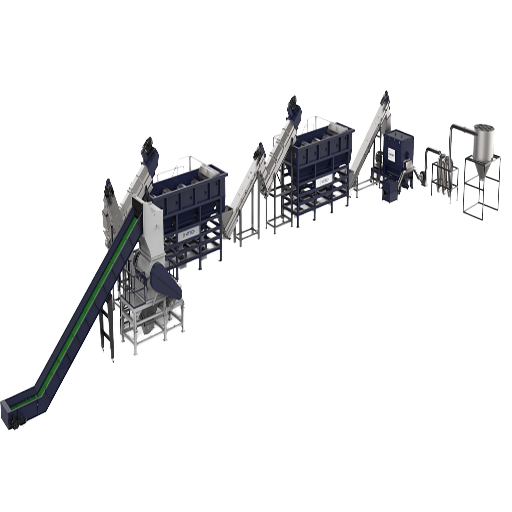
PET Bottle Washing Line
Hot Caustic Wash, float-sink separation, label removal, processing 500-3,000kg/hr from post-consumer PET bottles.
View PET Bottle Recycling System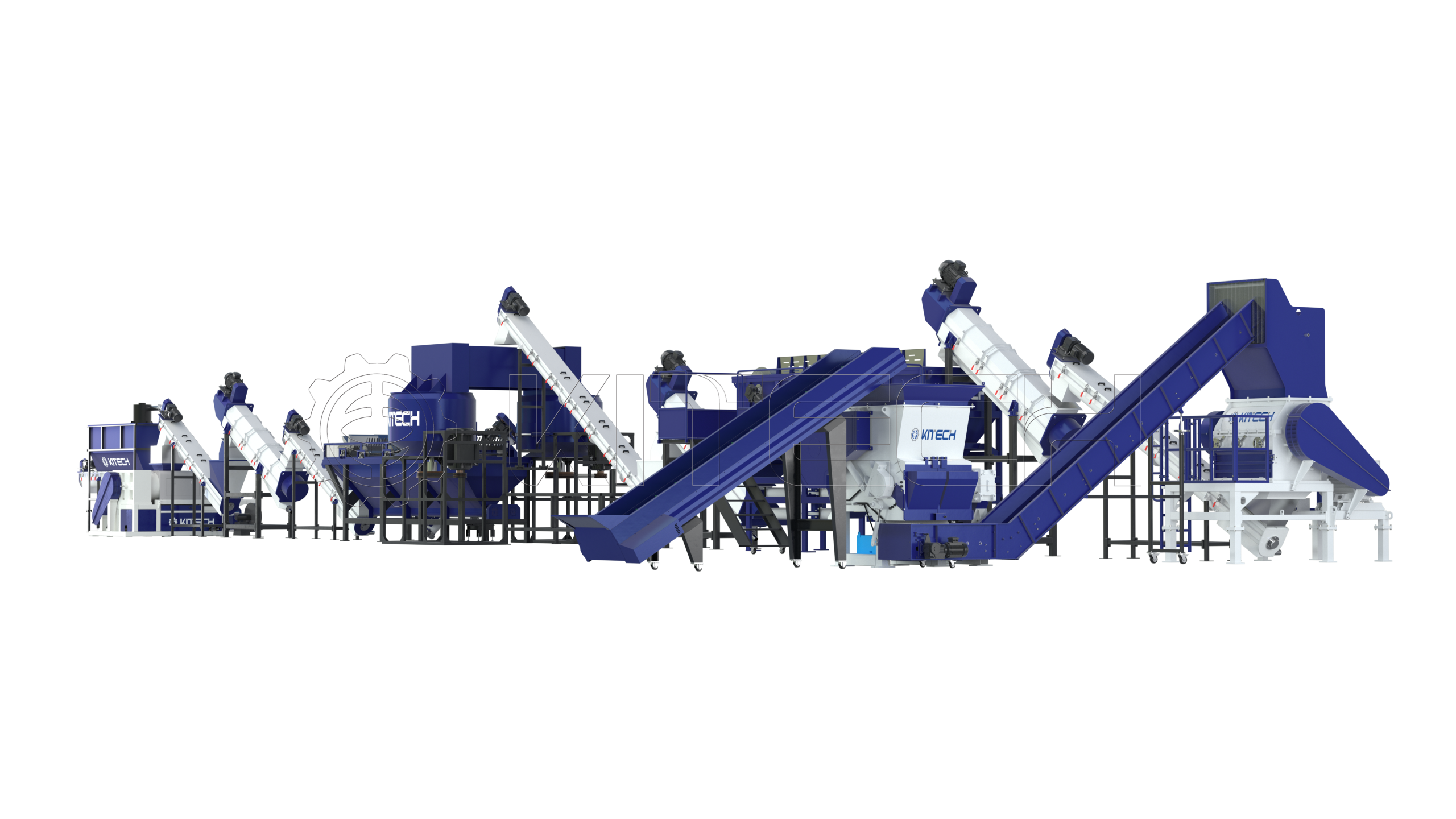
PE Film Washing Line
Friction washing, squeeze-drying, densification system for 300-1,000kg/hr post-industrial and post-commercial PE/LLDPE film and stretch-wrapping.
Explore PE Film Washing Systems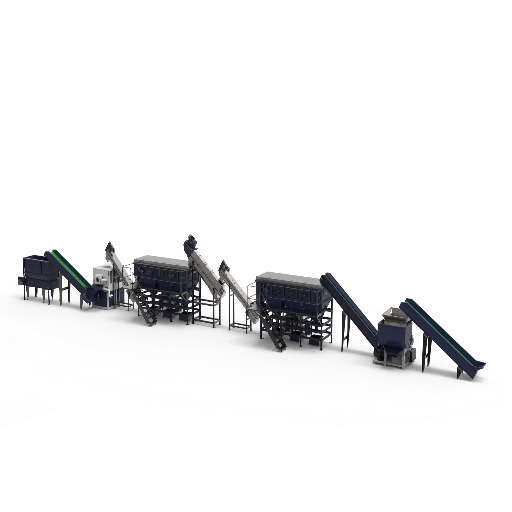
PP Woven Bag Recycling Line
Multi-stage decontamination for 300-800kg/hr woven Polypropylene bag and FIBC fabrication.
See PP Woven Bag Solutions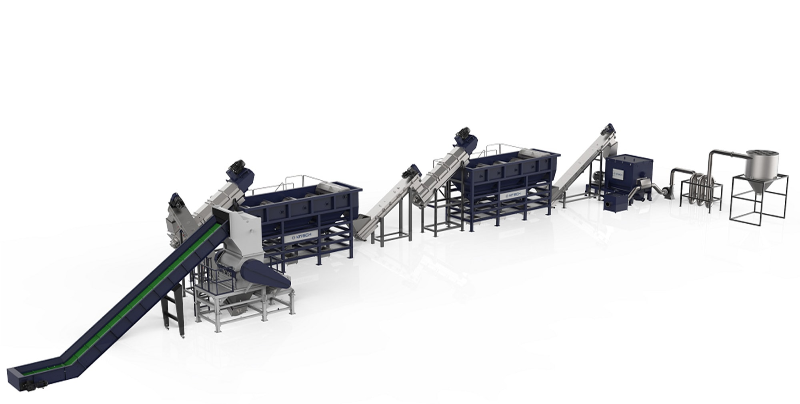
Rigid Plastic Recycling Line
Size reduction, washing, and pelletizing system for 500-2,000kg/hr of HDPE, ABS, PS, PC rigid plastics.
View Rigid Plastic Recycling Line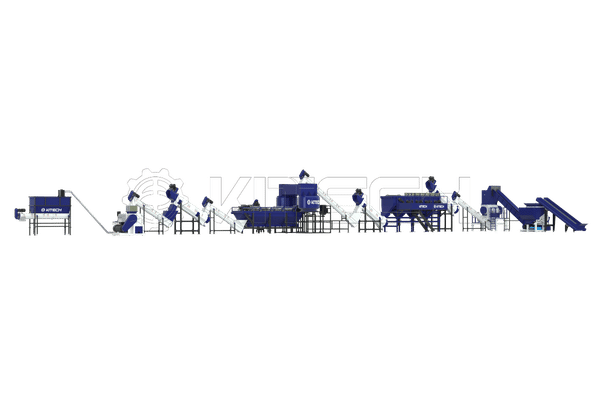
Agricultural Film Recycling Line
Post-consumer contamination removal system for 300-1,000kg/hr mulch film and greenhouse covers.
Agricultural Film Recycling Details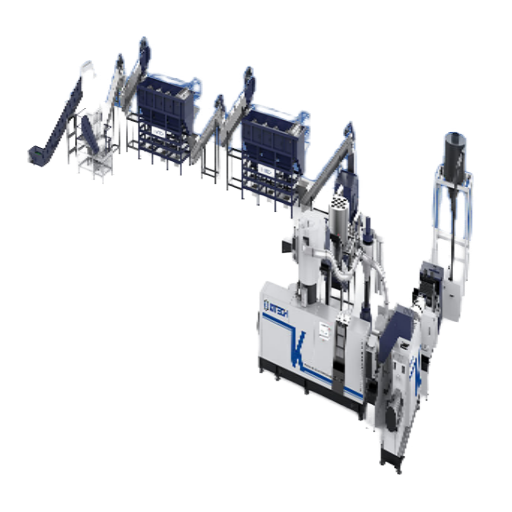
Drip Tape Recycling Line
Sand and soil separation conveyor belt with integrated pelletizer, for 200-500kg/hr irrigation drip tape.
Drip Tape Recycling Line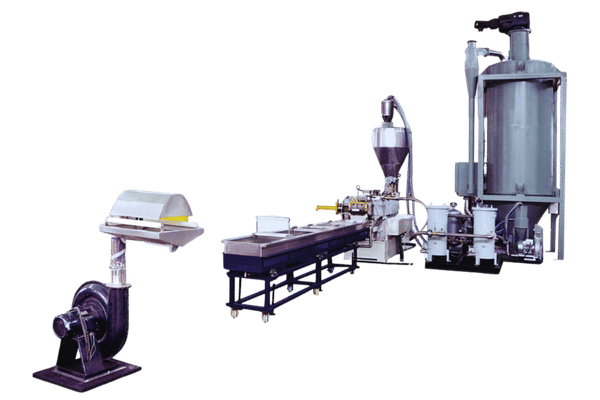
Plastic Pelletizing Line
Single- and two-stage extrusion with a melt filter system from 200-3,000kg/hr from pre-washed flakes of any Resin.
Explore Pelletizing SystemsUnsure which line fits?
Use our interactive selector tool to find the exact configuration for your material and capacity.
This is the typical end-to-end processing chain from raw waste to final product. If you require individual processing step equipment upgrades or replacements, our standalone machinery equipment list follows:
Plastic Recycling Equipment — Industrial Shredders, Washing Systems & Pelletizers
We produce standalone machinery, to compliment your existing facilities or increase your current processing throughput. All standalone-machinery equipment is CE, UL, and CSA certified in the same manner as our turnkey systems, and we provide integration assistance whenever needed.
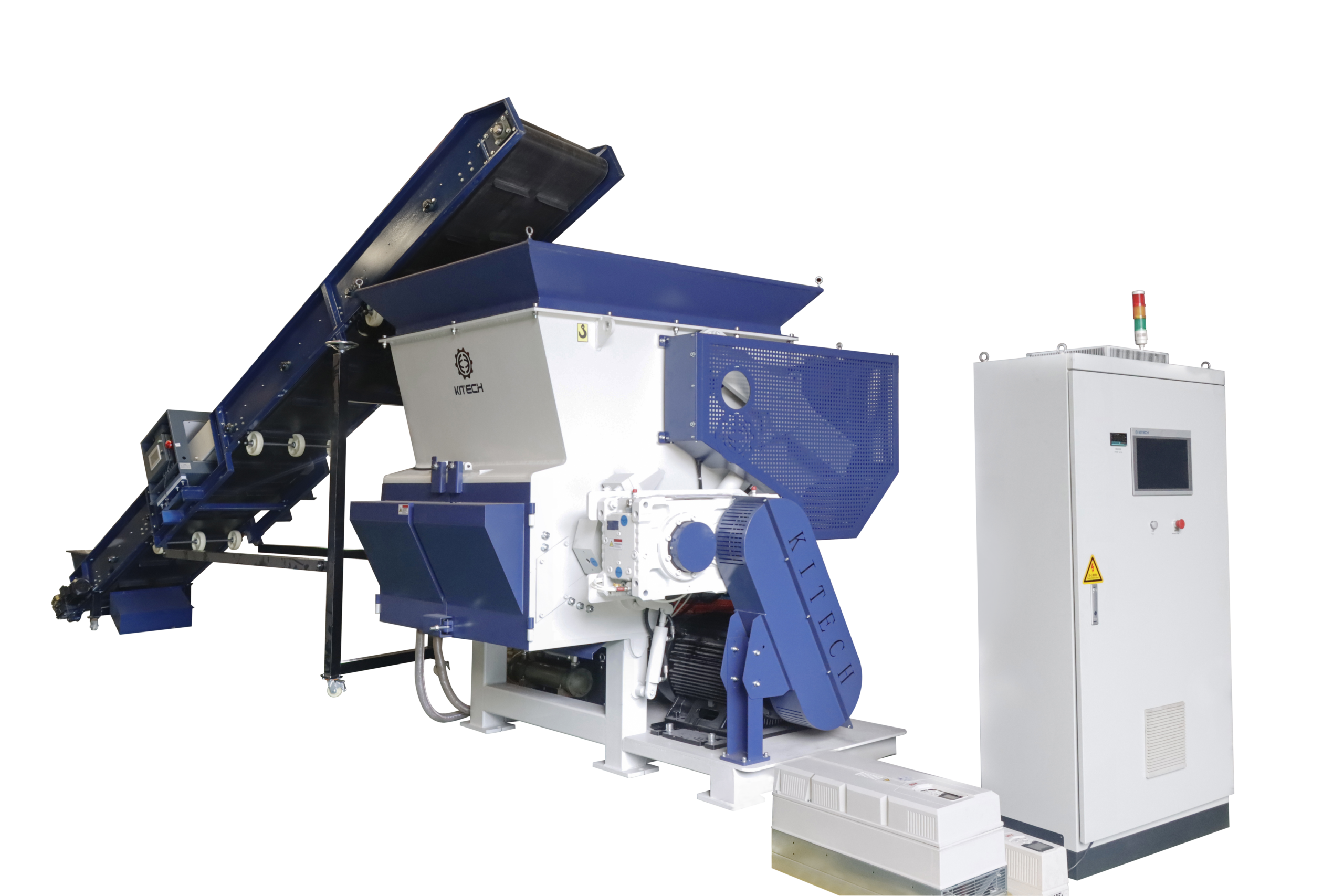
300-3,000 kg/h | D2/SKD-11 blades | 15-200 kW
Plastic Shredder
Shredders for bottles, film, rigid plastics, and commercial and industrial scrap in single shaft, dual shaft, and shear design configurations. Hardened D2 and SKD-11 blades offer long life under continuous operation.
View plastic shredder specifications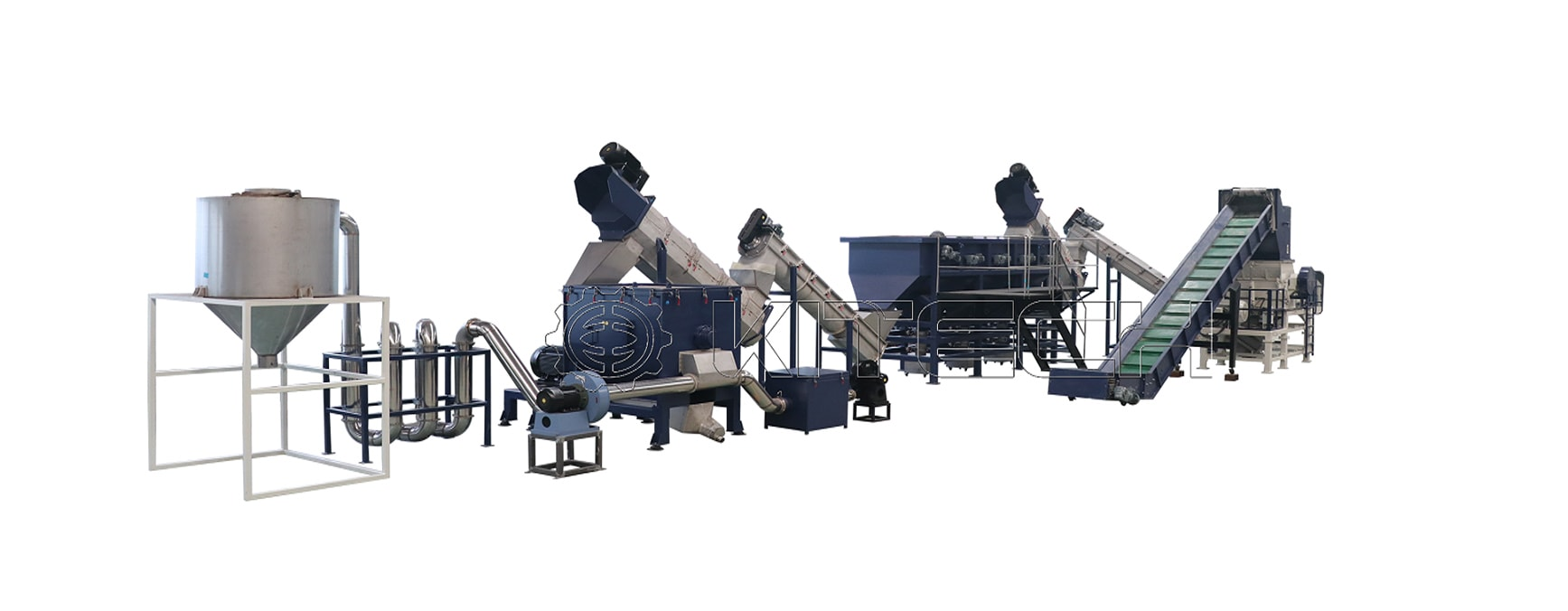
900-1,200 RPM friction | 60-85°C hot wash
Plastic Washing System
Hot and cold friction washing systems for contaminated flake and post industrial material. High-speed (900-1200 RPM) surface washers, low-temperature hot washers (60-85 degrees Celsius). float-sink washers, centrifugal dewatering units, and polishing water rings.
Explore plastic washing systems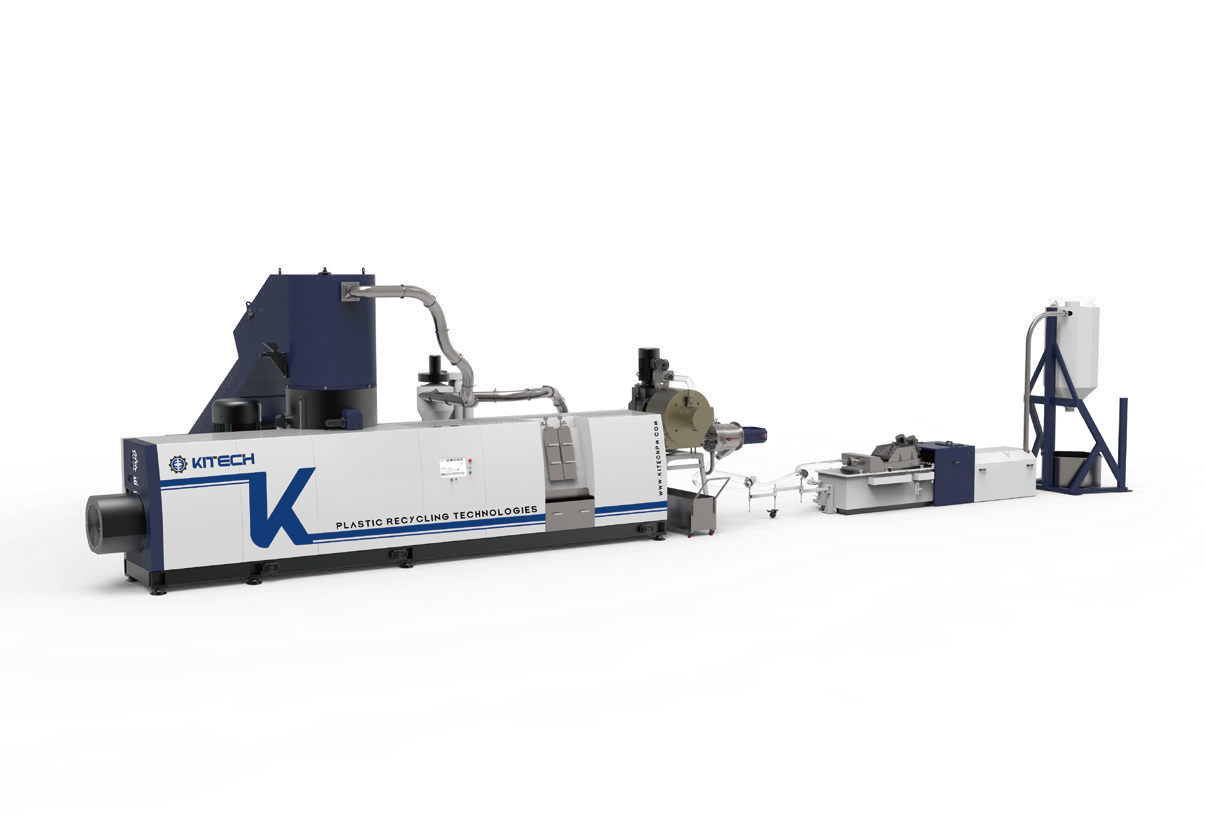
80-120 mesh filtration | Moisture <3%
Plastic Pelletizer
Wire and bottleneck pelletizing system with die-face granulation and tray die face, mega mouth strand chopping and water ring systems, and stainless steel granulating systems. Melt-filters of 80-120 mesh remove in-line impurities. Less than 3% residual moisture for injection molding and film blowing.
Plastic pelletizer details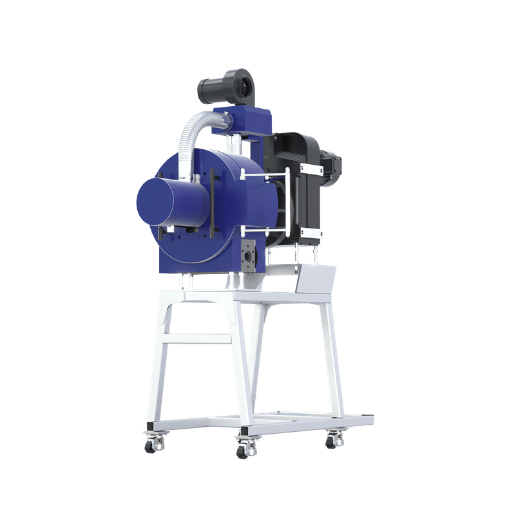
Conveyors | Metal detectors | Label removers | Silos
Auxiliary Machine
Supporting equipment to bring your system together: screw conveyor, belt conveyor, magnetic and air-cushion metal separators, in-line label removal, storage silos.
View auxiliary equipmentEquipment Selection by Material Type
The processing equipment design for your waste stream. The following matrix shows typical capacities for each equipment/material pair:
| Equipment | PET Bottles | PE/PP Film | Rigid Plastic | Agricultural Film | Woven Bags |
|---|---|---|---|---|---|
| Shredder | 500-3,000 kg/h | 300-1,000 kg/h | 500-2,000 kg/h | 300-1,000 kg/h | 300-800 kg/h |
| Friction Washer | 500-3,000 kg/h | 300-1,000 kg/h | 500-2,000 kg/h | 300-1,000 kg/h | 300-800 kg/h |
| Hot Washer | 500-3,000 kg/h | Not required | Optional | Not required | Not required |
| Float-Sink Tank | 500-3,000 kg/h | Not required | 500-2,000 kg/h | Not required | Not required |
| Pelletizer | 500-3,000 kg/h | 300-1,000 kg/h | 500-2,000 kg/h | 300-1,000 kg/h | 300-800 kg/h |
Not Sure Which Machinery Your Require? E-Mail for a Custom Equipment Recommendation:
How Plastic Recycling Machines Work — From Waste to Pellets
The 4 stages of plastic reprocessing are size reduction, contaminant removal, moisture control, and pelletizing. Each stage uses purpose-built equipment matched to your material’s size, contamination level, and moisture content. Here is how Kitech’s recycling process works in practice.
01
Shredding and Size Reduction
Single or two-shaft plastic crushers reduce your incoming waste streams into uniform granules 10-50 millimeters in size. Motor power requirement varies from 15 kw for light film grinding to 200 kw for heavy-walled HDPE drums and rigid ABS casings. Uniform particle size in this stage has a direct effect on washing efficiency and pellet shape down stream.
02
Washing and Contaminant Removal
Hot caustic washes at 60-85 degrees Centigrade dissolve as much adhesive and organic film residue as possible. Friction washers draw about 900-1,200 revolutions per minute tumble-shaped plastic pieces to mechanically erode surface dirt and impurities. Float-sink tanks are used in PET washing lines to sort PET (sink, IP density > 1.0 g/cm 3) versus PP/PE caps (float, density < 1.0 g/cm3). Custom-designed plastic washing systems are tuned to the types of contamination in your incoming feed stock.
03
Drying and Moisture Control
Centrifugal Dryers and screw-press dewatering units lower moisture content from 40 to below 3 percent. Small differences here make a large difference in pellet quality and extruder operation – excessive moisture causes blowing bubbles during extrusion and weak pellets. Flexible material recycling lines incorporate a squeeze press prior to drying due to high moisture retention in films.
04
Pelletizing and Quality Control
Two- or single-stage extruders with 80-120-mesh melt filters remove microlevels of dirt and dyes. Three types of pelletizer are offered for dedicated applications: strand-die cutter pellets a batch, water ring pellets an even, high-mileage pellet, and a die face cutter for by-the-hour high production runs. The completed pellets are clean and ready for the next step in manufacturing.
[ ENGINEERING NOTE ]
Technical Deep-Dive: PET vs PE/PP Separation
PET and PE/PP require:
- fundamentally different separation procedures
- PET sinks, other plastics float in water (interestingly, its specific gravity is > 1.0 g/cm 3)
- PE and PP meet the water, so are separated on this basis
- in a PET bottle washing line, water float sink tanks separate PET flakes from label and cap remnant fragments
- in flexible recycling lines, float sink tanks are omitted entirely; instead, hot water washing, friction rinsing, and squeeze after-drying are used to achieve acceptable output quality
- application of mixed processes–running films through float sink tanks, or avoiding hot wash in PET–adversely impacts output quality and throughput
Why Kitech — CE, UL & CSA Certified Across 80+ Countries
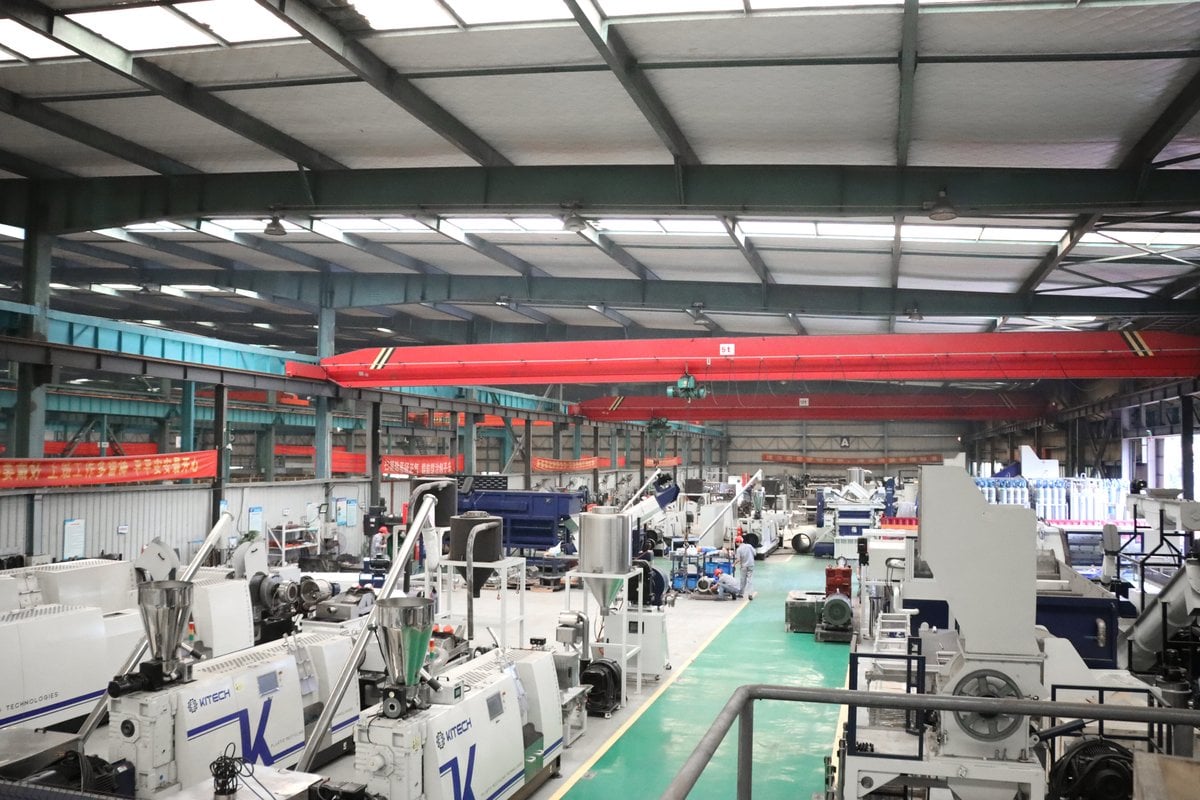
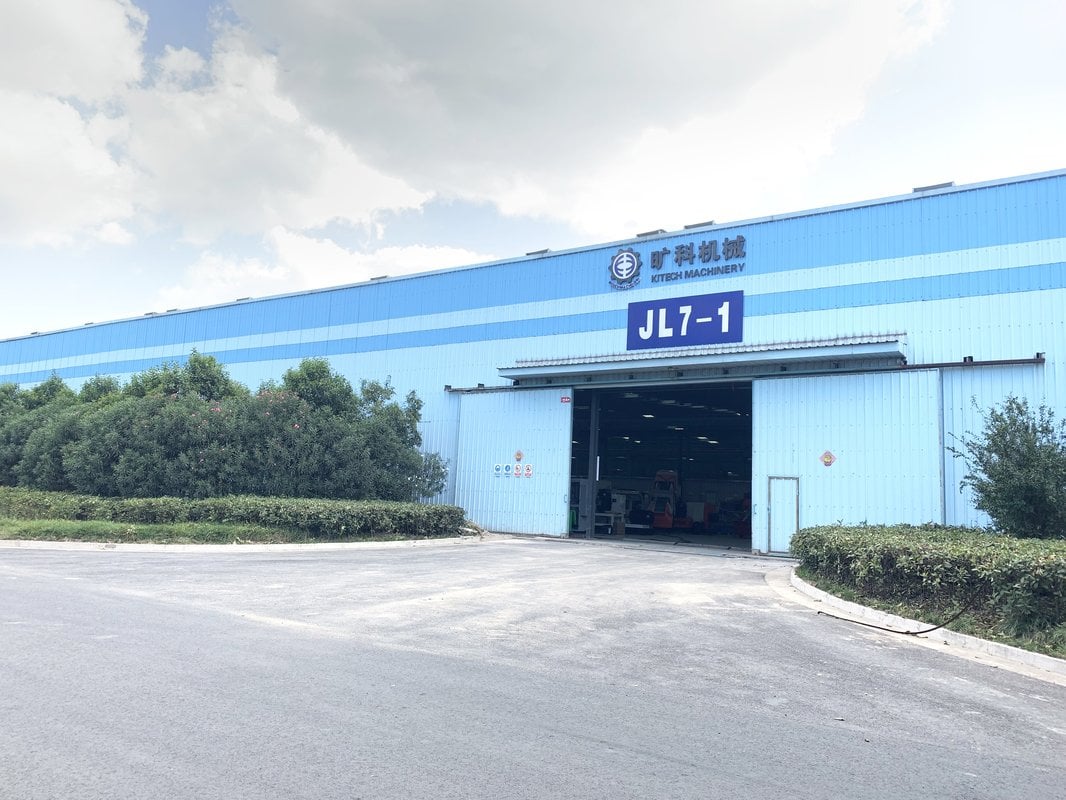
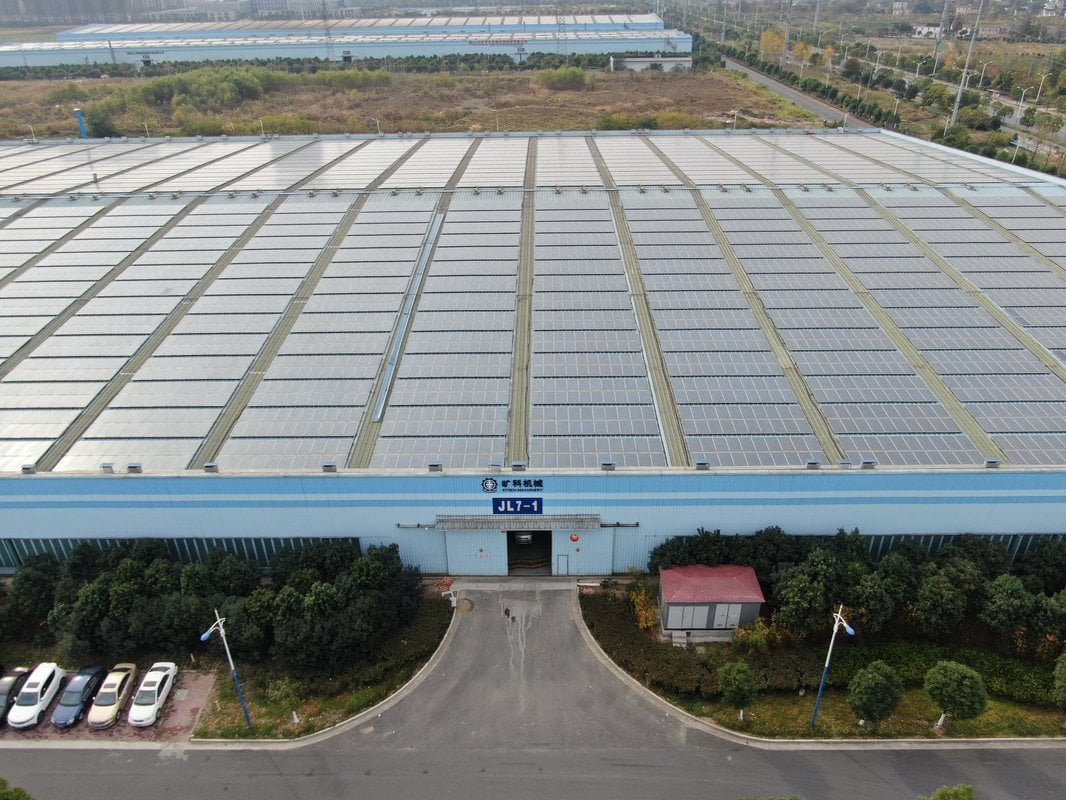
Kitech produces over 500+ recycling installations in more than 80 countries. These range from PET bottle washing systems processing hundreds of tons of plastics everyday in extreme conditions in southeast Asia, to large scale rigid plastics businesses processing millions of kilograms every day in Europe, to rolled agricultural film plants operating in South America.
CE Certified
EU Machinery Directive 2006/42/EC
UL Listed
UL 746S Polymeric Materials
CSA Approved
Canadian Standards Association
500+ Installations
Active worldwide
80+ Countries
Global market coverage
60-Day Delivery
Guaranteed shipment
/01
European Engineering Heritage
Original European engineering never goes out of style. Kitech applies the same scientific approach to build our equipment to achieve the highest uptime and longest service life. Our shredder blades feature D2 and SKD-11 tool steel. Our washing systems monitor even temperature regulation in multi-tank systems. Our pelletizers cut perfectly shaped pellets to strict dimensional tolerances.
/02
Triple Safety Certification
Our CE, UL, and CSA certifications ensure you can sell your equipment throughout the EU, in North America, and every where in between. Few manufacturers of plastics recycling equipment ever attain all three standards. If you intend to sell into Europe or North America, or require equipment certification for your financial institution, you need us.
/03
60-Day Guaranteed Delivery
Dedicated manufacturing teams and leading edge production techniques ensure equipment delivery within 60 calendar days of order confirmation. Our standard line configurations deliver on time every time. These delivery assurances enable you to plan civil works and electrical infrastructure and staffing levels based on a firm system commissioning date, not a tentative guess.
/04
Global Support Network
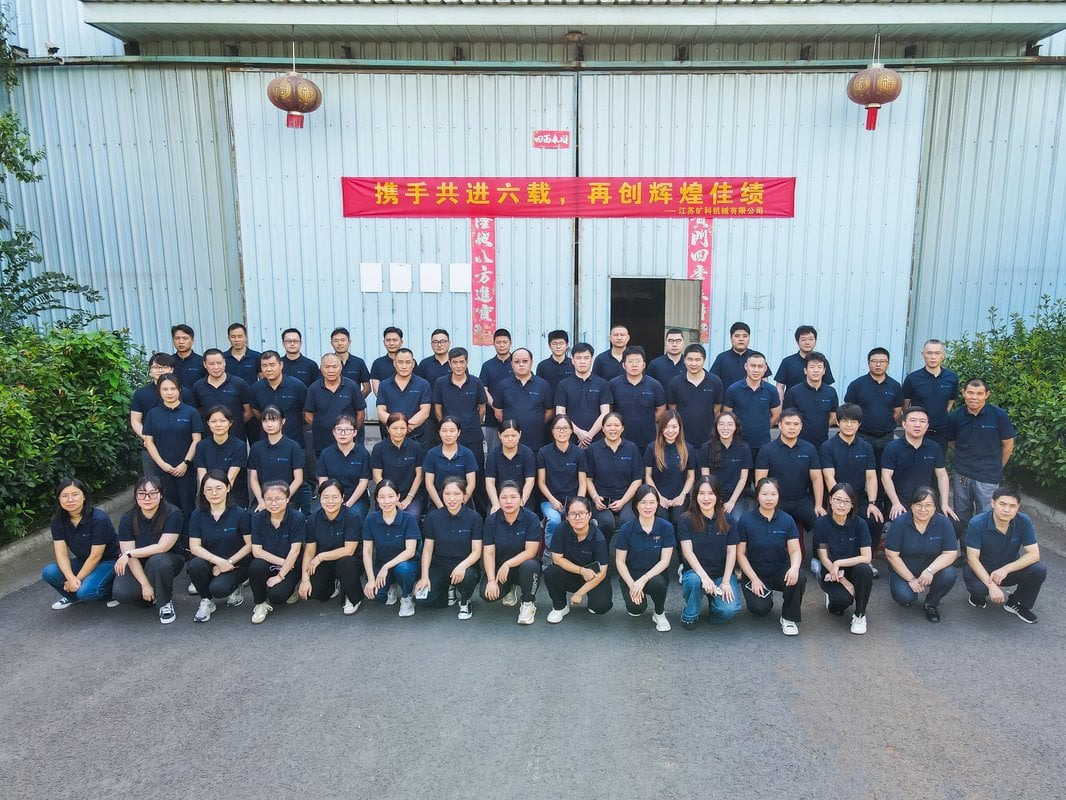
Our global network of trained representatives supplies professional installation, lightning response maintenance programs and round-the-clock technical support when you need spare parts, and advice in the middle of the night. When you require mobile service or equipment training at your site, our regional representatives arrive prepared with the correct parts in hand.

Buyer Advisory
Check the documentation from us to confirm CE, UL, and CSA approvals for your application. These certifications sound safety performance standards and integrate your equipment with existing regulation in your end-use country. Request certification documentation with the standard number (e.g.CE: 2006/42/EC UL: 746S, CSA: C22.2) and search for it with the issuing organization.
Confirm Our Product Certifications for your application
Download Compliance Docs
SYS_APP_MATRIX_DATA
Plastic Recycling Machine Applications by Industry
Waste streams vary by application, and matching each system to your raw material profile drives higher output quality and throughput. The chart below matches each of the six standard plastic recycling industries to the Kitech system best suited to achieve maximum output quality for that stream.
Industry
Waste Stream
Typical Capacity
Recommended System
Industrial Manufacturing
HDPE drums, ABS casings, PP bins
500-2,000 kg/h
Every System Configuration Can Be Tailored
To your different raw material specifications – impurity load, moisture factors, desired product qualities, and application throughput demands. A system designed to produce highly pure automotive plastics operates at different water flow and chemical dosing levels than a system designed to produce bottled PET flakes.
FINANCIAL_SYS_DATA
Plastic Recycling Machine Cost & Investment Guide
The total cost of a plastic recycling system hinges on your material specifics, contamination level, output goal, and degree of automation required. Since pricing is not addressed by many equipment suppliers, there is little basis for a realistic budget study during project planning. Here is a summary of typical initial system investments.
| Equipment Type | Capacity Range | Typical Investment |
|---|---|---|
| Plastic Shredder | 300-3,000 kg/h | $3,000 – $100,000 |
| Granulator | 200-1,500 kg/h | $5,000 – $50,000 |
| Washing Line (Film) | 300-1,000 kg/h | $80,000 – $250,000 |
| Washing Line (PET Bottles) | 500-3,000 kg/h | $180,000 – $600,000 |
| Pelletizing System | 200-3,000 kg/h | $30,000 – $250,000 |
| Complete Turnkey Line | 500-3,000 kg/h | $150,000 – $2,000,000+ |
Source: Industry benchmarks, 2025-2026
Buyer Advisory: Hidden Costs to Budget For
Quality control measures account for 40-50% of the total project investment. Consider: civil works (foundations, drainage), electrical infrastructure, water management, sorting infrastructure, spare parts, commissioning with operator training. As a guide, expect your budget to be approximately twice the equipments list price.
Kitech will provide your specific application sales quotation within 48 hours of receipt of your material analysis.
Request Your Custom Quote →
SYS_QUERY_DB
Frequently Asked Questions About Plastic Recycling Machines
What equipment do I need to start a plastic recycling business?
The basic machinery chain is shredder, washer, and pelletizer. Depending on the waste stream, level of contamination, and desired end-product yield your choice of equipment will vary. Recycling for PET bottles will use hot caustic washer and float-sink separation. Film recycling will use friction washer and densification stage. Kitech supplies complete turnkey lines for both waste streams, with throughputs of 200 – 3,000 kg/h. To start up a new plant we advise you to purchase a turnkey solution incorporating every step in the process, conveyors and control panels – then all equipment will be upgraded for capacity and not mismatched.
How much does a plastic recycling machine cost?
Isolated shredder units range from $3,000 for small capacity down to $100,000+ for industrial twin-shaft units. Complete washing and pelletizing systems run $150,000 to over $2,000,000 depending on throughput and waste stream. Factor in that total project investment — site infrastructure, installation, commissioning — typically doubles the equipment purchase price.
What is the payback period for plastic recycling equipment?
Industry comparisons show 18-36 months payback on investement using conservative equipment ramp-up estimates, with consideration of market losses, production downtime, and delays in starting-up. Important variables in the model are feedstock (raw material) cost, the average sales value of the recycled pellets (PET flakes: $0.30-0.60/pound, HDPE pellets: $0.40-0.70/pound), and equipment availability. Operations processing postconsumer PET bottles at a 1,000+kg/hr linear throughput rate offering short-term contracted purchases generally realize the shortest pay-back periods.
Which type of plastic recycling is most profitable?
Recycling PET bottles and HDPE rigid plastics are generally most lucrative due to established end markets and consistent sales to packaging and bottle manufacturers. Recyled pellets are priced at a 20-40% premium to flakes. Operational viability depends on availability of local feedstock, fuel costs and proximity to end markets. Higher margin operations investing in agricultural film recycling are equally profitable where feedstock supply is available in low-cost quantities – although higher level of washing is needed to remove contamination levels.
How long does it take to deliver a plastic recycling machine?
Kitech guarantees equipment shipment within 60 calendar days of order confirmation for standard configurations. Custom frame sizes and atypical capacities may require additional lead time, defined during the bidding process. Our on-time delivery record is backed by dedicated production teams for each product line. Plan your civil and electrical works in parallel — foundations, drainage, and power connections should be ready when the equipment arrives on site. We provide installation drawings and utility requirement lists at the time of contract signing so your contractors can start groundwork immediately.
What safety certifications should plastic recycling equipment have?
Three certifications matter: CE (EU Machinery Directive 2006/42/EC), UL (UL 746S), and CSA (C22.2). Kitech equipment carries all three — ensuring market access across the EU, US, and Canada.
Can one recycling line handle multiple types of plastic waste?
Different plastics PET, PE, PP, HDPE have distinct density, melting and contamination attributes which require different processing parameters; you cannot feed a PET bottle washing line with PE film and get an acceptable throughput rate. The washing temperatures, separation techniques, and drying parameters are fundamentally different for each resin type. Kitech builds 7 dedicated recycling lines, each engineered for a specific waste stream to deliver the highest throughput and pellet quality. If you have several feedstocks, we can configure separate lines fed through same infrastructure to minimize your total investment.
Our Engineering Commitment to Plastic Recycling
Kitech lines specifications, capacity ranges and infeed certification data in this brochure date from 2026 and are current. The pricing tests used here draw from the broad market data – your investment depends on line features, material specification and project scope. We work with 500+ plastic recycling customers in 80+ countries and every line leaves our factory with UL, CE and CSA certification papers. For specific project values, our project engineering team will respond with a formal quote within 48 hours of sample analysis reception.